
A Microsoft Research paper has listed out 40 professions it believes are most at risk from the rise of AI, as well as 40 professions that should be safe (at least for now…)
It’s RIP for journalists (🥲), and many other professions, according to Microsoft Research.
In a new paper recently published by Microsoft’s research division, a team of data scientists revealed a variety of professions most likely to be impacted by AI based on a variety of factors. The team studied the United States job market specifically, although it stands to reason that, without some form of global regulation, these predictions could apply to virtually any developed or developing nation right now.
Microsoft Senior Researcher Kiran Tomlinson described the study as such, “Our study explores which job categories can productively use AI chatbots. It introduces an AI applicability score that measures the overlap between AI capabilities and job tasks, highlighting where AI might change how work is done, not take away or replace jobs.” Tomlinson continued, “Our research shows that AI supports many tasks, particularly those involving research, writing, and communication, but does not indicate it can fully perform any single occupation. As AI adoption accelerates, it’s important that we continue to study and better understand its societal and economic impact.”
Indeed, the study determines how “applicable” AI is to certain job roles, which in theory could be used to enhance productivity therein, but in practice, will most likely be used to justify reducing team sizes — outsourcing human work to AI models. Microsoft itself is thought to have laid off over 15,000 people this year due to the “application” of AI, and prioritizing its growth over other parts of the business. If AI can make a single individual in a company “more productive,” potentially doing the work of two people, it conceivably justifies eliminating roles. So far, there’s no evidence that AI has led to job creation in most, if any, of the careers listed below. Much to the contrary, former Microsoft CEO Bill Gates himself has rang alarm bells about how AI will destroy jobs.
Microsoft is at the absolute forefront of artificial intelligence, with its Azure data centers contributing processing power to models like ChatGPT, DALL-E, and Grok. Its Copilot chatbot is baked into Windows, and its business-grade solutions in Microsoft 365 aim to help users save time by offloading more menial tasks.
Increasingly, though, it seems that both current and future AI models will be able to not only offload those menial tasks but also replace entire professions. AI at scale could lead to a variety of unknown consequences that governments and society at large seem ill-prepared for — but perhaps there are opportunities around the corner, too?
In any case, here’s the list of 40 jobs most impacted by AI, and the 40 least impacted, according to Microsoft Research.
| # | Job Title | Employment |
|---|---|---|
| 1 | Interpreters and Translators | 51,560 |
| 2 | Historians | 3,040 |
| 3 | Passenger Attendants | 20,190 |
| 4 | Sales Representatives of Services | 1,142,020 |
| 5 | Writers and Authors | 49,450 |
| 6 | Customer Service Representatives | 2,858,710 |
| 7 | CNC Tool Programmers | 28,030 |
| 8 | Telephone Operators | 4,600 |
| 9 | Ticket Agents and Travel Clerks | 119,270 |
| 10 | Broadcast Announcers and Radio DJs | 25,070 |
| 11 | Brokerage Clerks | 48,060 |
| 12 | Farm and Home Management Educators | 8,110 |
| 13 | Telemarketers | 81,580 |
| 14 | Concierges | 41,020 |
| 15 | Political Scientists | 5,580 |
| 16 | News Analysts, Reporters, Journalists | 45,020 |
| 17 | Mathematicians | 2,220 |
| 18 | Technical Writers | 47,970 |
| 19 | Proofreaders and Copy Markers | 5,490 |
| 20 | Hosts and Hostesses | 425,020 |
| 21 | Editors | 95,700 |
| 22 | Business Teachers, Postsecondary | 82,980 |
| 23 | Public Relations Specialists | 275,550 |
| 24 | Demonstrators and Product Promoters | 50,790 |
| 25 | Advertising Sales Agents | 108,100 |
| 26 | New Accounts Clerks | 41,180 |
| 27 | Statistical Assistants | 7,200 |
| 28 | Counter and Rental Clerks | 390,300 |
| 29 | Data Scientists | 192,710 |
| 30 | Personal Financial Advisors | 272,190 |
| 31 | Archivists | 7,150 |
| 32 | Economics Teachers, Postsecondary | 12,210 |
| 33 | Web Developers | 85,350 |
| 34 | Management Analysts | 838,140 |
| 35 | Geographers | 1,460 |
| 36 | Models | 3,090 |
| 37 | Market Research Analysts | 846,370 |
| 38 | Public Safety Telecommunicators | 97,820 |
| 39 | Switchboard Operators | 43,830 |
| 40 | Library Science Teachers, Postsecondary | 4,220 |
A lot of the jobs in the top 40 revolve entirely around what LLMs like ChatGPT seem to be able to do best. It’s all largely impersonal, easily digitizable work that can be reproduced easily by AI. I ranked the table by how the research describes AI applicability, which refers to how often AI was being utilized by individuals in these professions.
I was surprised to see professions like modelling on the list, but it makes sense when you can easily ask ChatGPT or Copilot to generate an image of a “model” doing anything you want with a simple command prompt. It seems Microsoft Research thinks AI will be able to even reproduce my awesome Xbox exclusives in the future too … damn.
Perhaps I should consider a career in phlebotomy, or become a masseuse?
| # | Job Title | Employment |
|---|---|---|
| 1 | Dredge Operators | 340 |
| 2 | Bridge and Lock Tenders | 3,460 |
| 3 | Water Treatment Plant and System Op. | 120,710 |
| 4 | Foundry Mold and Coremakers | 2,700 |
| 5 | Rail-Track Laying and Maintenance Equip. Op. | 4,010 |
| 6 | Pile Driver Operators | 3,010 |
| 7 | Floor Sanders and Finishers | 4,510 |
| 8 | Orderlies | 48,710 |
| 9 | Motorboat Operators | 2,710 |
| 10 | Logging Equipment Operators | 23,720 |
| 11 | Paving, Surfacing, and Tamping Equipment Op. | 43,080 |
| 12 | Maids and Housekeeping Cleaners | 836,230 |
| 13 | Roustabouts, Oil and Gas | 43,880 |
| 14 | Roofers | 135,140 |
| 15 | Gas Compressor and Gas Pumping Station Op. | 4,400 |
| 16 | Helpers–Roofers | 4,540 |
| 17 | Tire Builders | 20,660 |
| 18 | Surgical Assistants | 18,780 |
| 19 | Massage Therapists | 92,650 |
| 20 | Ophthalmic Medical Technicians | 73,390 |
| 21 | Industrial Truck and Tractor Operators | 778,920 |
| 22 | Supervisors of Firefighters | 81,120 |
| 23 | Cement Masons and Concrete Finishers | 203,560 |
| 24 | Dishwashers | 463,940 |
| 25 | Machine Feeders and Offbearers | 44,500 |
| 26 | Packaging and Filling Machine Op. | 371,600 |
| 27 | Medical Equipment Preparers | 66,790 |
| 28 | Highway Maintenance Workers | 150,860 |
| 29 | Helpers–Production Workers | 181,810 |
| 30 | Prosthodontists | 570 |
| 31 | Tire Repairers and Changers | 101,520 |
| 32 | Ship Engineers | 8,860 |
| 33 | Automotive Glass Installers and Repairers | 16,890 |
| 34 | Oral and Maxillofacial Surgeons | 4,160 |
| 35 | Plant and System Operators, All Other | 15,370 |
| 36 | Embalmers | 3,380 |
| 37 | Helpers–Painters, Plasterers, … | 7,700 |
| 38 | Hazardous Materials Removal Workers | 49,960 |
| 39 | Nursing Assistants | 1,351,760 |
| 40 | Phlebotomists | 137,080 |
I ranked these jobs via the score given by Microsoft Research, which scored jobs based on how applicable AI is to their roles.
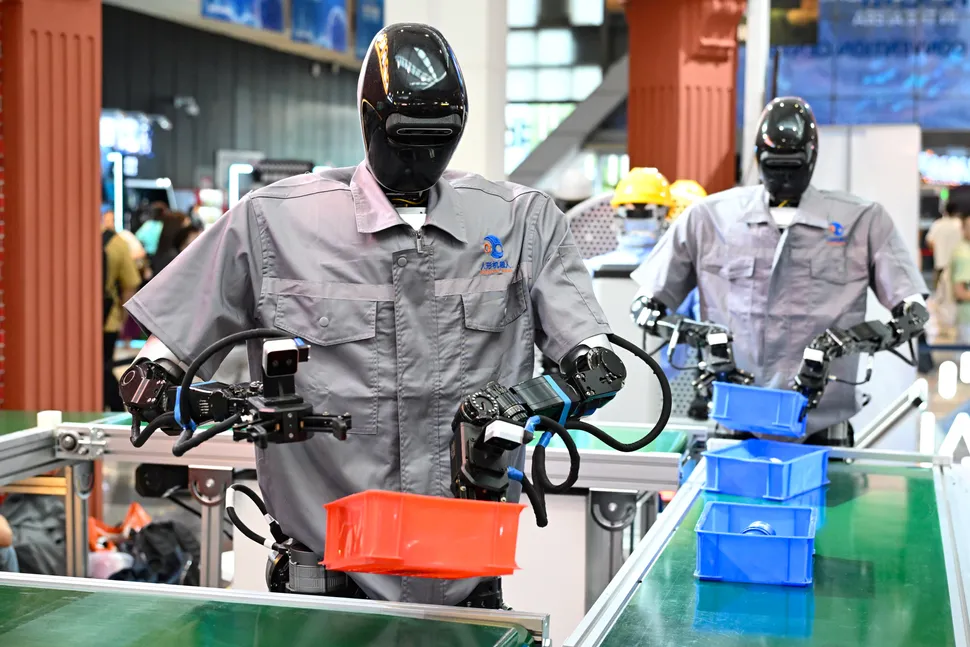
The jobs least at risk are ones that seem to require a physical human touch, literally in some cases. Jobs like massage therapists, builders, roofers, engineers, and surgeons seem safe from AI today. But it’s certainly true that robots are becoming increasingly sophisticated and tactile as well — you’d have to think that it’s only a matter of time before humanoid robots, designed by AI itself, could supplant a lot of these roles as well.
It’s all getting a bit Matrix-y, isn’t it?
The AI upheaval will have massive consequences, for better or worse

Artificial Intelligence is going to have massive implications for the world, much like the industrial revolution did back in the 1800s. I often see investors and technologists hand-wave and apply analogies like “cars destroyed the horse and cart industry,” but increasingly, we’re seeing governments waking up to the absolute carnage this technology could wreak.
With our entire economic system revolving around work, and increasingly white collar work, vast unemployment, the likes of which has never been seen before, could trigger all sorts of social turmoil. Governments certainly seem ill-prepared for the AI worst-case scenario situations, even before you consider artificial general intelligence and self-replicating improvement models that are on the horizon.
AI could turbocharge inequality and wealth disparity, with societies voting for populist candidates who promise a world of change while delivering more of the same. There’s only so much bullshit society can take, and AI could be the spark to tip it over the edge.
But what about the benefits? AI could speed up disease and cancer solutions, able to experiment, comprehend, and parse data far faster than huge teams of scientists could manually. Perhaps AI itself comes up with economic solutions to solve the looming unemployment crisis, with some form of distributed universal basic income, touted by some, as freeing humanity from the toils of work in general.
Over to you!
Overall, will artificial intelligence help, or hurt human society?
Help society.
I don’t know.
Hurt society.
I tend to gravitate towards more cynical expectations about the future — but much like the industrial revolution, it created plenty of turmoil, but it’s undeniable how it advanced society as a whole. It created entirely new industries and opportunities and vastly boosted life expectancies globally, owing to things like industrialized agriculture, advances in medicine, and so on.
Will AI create as many jobs as it eliminates, though? Or eliminate the need to work completely? Will we end up as a fusion-powered space-faring species? Or, could we all end up in The Matrix or Terminator?
I guess we won’t have to wait too long to find out. What do you think?
Join the conversation
Is AI a big threat to humanity?How do you feel about AI? Was your job on the list? Let us know.