
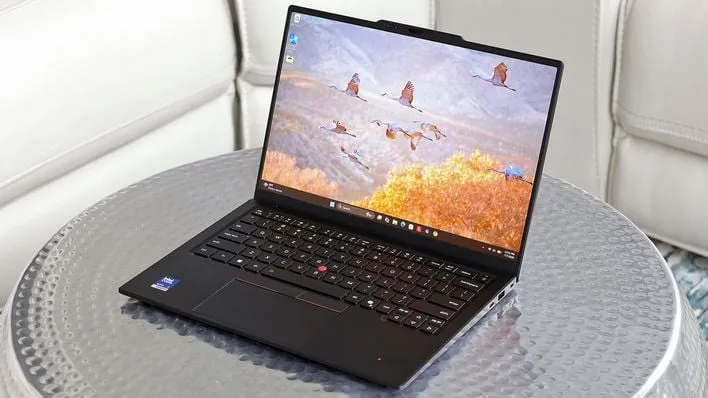
 Great OLED display Exceptional battery life Excellent laptop sound Fantastic keyboard and trackpad Delightfully light |  Webcam could be higher resolution A touch of flex in the keyboard Sometimes middling performance depending on CPU config No Intel 12 Xe Graphics option |
Our review configuration pairs Intel’s Core Ultra 7 355 processor with 32GB of LPDDR5X memory, a 512GB PCIe Gen4 SSD and a gorgeous 14-inch 2880×1800 OLED display with a 120Hz variable refresh rate. This is a premium configuration aimed squarely at professionals who demand class-leading portability without sacrificing performance, but does it deliver on those needs? Let’s dive in…
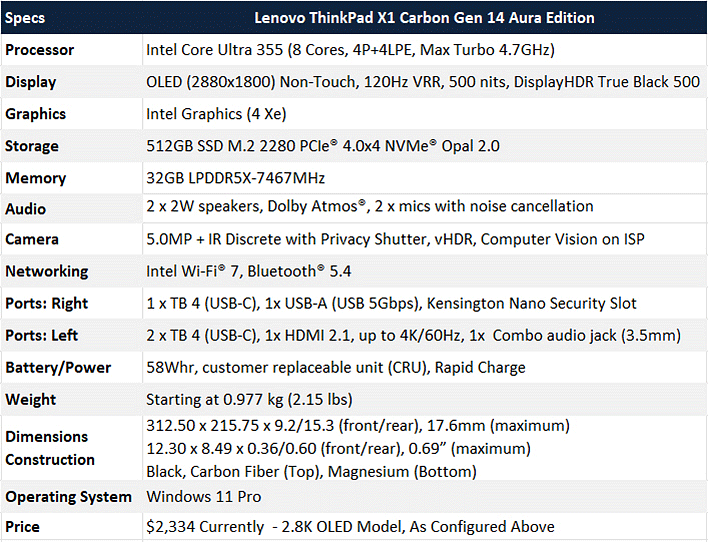
The test system Lenovo sent weighs just 2.15 pounds (0.977kg), making it one of the lightest premium 14-inch laptops currently available. Lenovo also offers multiple configurations with different processors, memory capacities, displays and storage options. Of note is that my system was equipped with LPDDR-5X-7467MHz memory, versus the 9600MHz memory configured in Dell’s new XPS 14 that we recently reviewed. Lenovo does offer up to 64GB of LPDDR-5X-9600MHz memory on higher-end Core Ultra 7 365 VPro SKUs.
ThinkPad X1 Carbon Gen 14 Design, Build Quality, Display, Audio & I/O
Although Lenovo hasn’t dramatically altered the X1 Carbon’s appearance, the engineering beneath the surface is significantly different. The new X1 Carbon Gen 14 introduces what Lenovo calls its Space Frame chassis. Rather than simply making the notebook thinner, Lenovo redesigned the motherboard layout, reducing its main system board footprint by roughly 20 percent. That reclaimed internal volume is now occupied by a larger onboard thermal solution, including fans that Lenovo says are approximately 70 percent larger than before. The result is improved sustained thermal performance while maintaining its exceptionally light chassis.


Connectivity is equally well thought out. Lenovo chose not to force users into an all-USB-C solution (like the aforementioned Dell XPS machine) with dongles to accommodate legacy ports. Instead, Lenovo includes three Thunderbolt 4 ports, alongside HDMI 2.1, USB-A, a 3.5mm headset jack and optional Nano SIM support. It’s a practical selection that should minimize the need for dongles or adapters, whether you’re at the office or on the road. And yes, ladies and gents, we have USB-C charging ports (both Thunderbolt 4) on either side of the machine. Most excellent, Lenovo.
The chassis of this laptop doesn’t feel overly rigid with its featherweight construction. There’s is a bit of typing deck flex, though it’s not too spongy thankfully. This laptop’s lid does resist twisting relatively well, and overall fit and finish are exactly what we’ve come to expect from Lenovo’s flagship ThinkPad line.
Another welcome improvement is serviceability. Ultralight laptops are rarely easy to repair, but Lenovo specifically designed this generation with easier access to internal components, earning an impressive 9/10 iFixit repairability score, which is almost unheard of in this class. More on this later in our teardown.

As always, the ThinkPad also meets MIL-STD 810H durability standards and incorporates recycled materials throughout its construction, from the magnesium chassis and carbon fiber top cover, to its battery and keyboard components.
The keyboard continues to be one of the best available on any laptop. The 1.5mm key travel provides satisfying tactile feedback without feeling mushy, while the layout remains familiar for longtime ThinkPad users. The signature TrackPoint is still present for those who prefer it, complemented by a spacious 120mm glass touchpad that tracks accurately and supports Microsoft’s Precision drivers.


The display’s 2880×1800 resolution strikes a nice balance between sharpness and desktop scaling, while its 120Hz refresh rate makes Windows navigation noticeably easier on the eyes than traditional 60Hz business screens. Colors are vibrant thanks to full DCI-P3 coverage, deep blacks are excellent, and HDR content benefits from the panel’s DisplayHDR True Black 500 certification. For productivity work, the anti-glare coating also does an admirable job reducing reflections without noticeably muting image quality.
Lenovo also outfits the X1 Carbon with a 5MP webcam paired with an IR sensor for Windows Hello facial recognition, along with a physical privacy shutter for users who prefer an extra layer of security when the camera isn’t in use.
Audio is another pleasant surprise. The Dolby Atmos speaker system on board delivers fuller sound than most ultralight notebooks, with respectable stereo separation and enough volume for video conferencing or media consumption. There’s even a bit of low-end bass response, which is all too uncommon, especially in laptops of this weight class. Finally, Lenovo also includes dual-array microphones enhanced with Dolby Voice processing for improved voice pickup and background noise suppression during meetings.
X1 Carbon Gen 14 Aura Edition Software Experience And Utilities
On the software side, Lenovo’s Aura Edition features are designed to simplify everyday use and maintenance of the machine. Smart Modes automatically adjust system behavior depending on how you’re using the notebook, while Smart Share enables quick file transfers between supported Android and iOS devices. Smart Care provides direct access to Lenovo technical support through integrated software. These additions won’t be deciding factors for most buyers, but they’re thoughtful conveniences that integrate cleanly with Lenovo Vantage.


Beyond Microsoft’s Copilot+ features, Lenovo’s Vantage software continues to be one of the more polished OEM maintenance utilities. It provides a central hub for firmware updates, diagnostics, battery management, performance profiles and Aura Edition features, making it easy to customize the notebook without digging through Windows settings. It’s a refined software suite that brings genuine convenience, rather than unnecessary clutter.
Let’s look at the performance characteristics of Lenovo’s new ThinkPad X1 Carbon, next…